Probably one of the best reasons to create a 12-month money plan for irregular expenses is to use up your office supplies, forget the plan, and proceed drowning in blissful ignorance of your finances, which would lead you to the decision to make a money plan for the 12 months that come after those 12 months.
The second best reason is to test how life would feel if you actually knew what was happening with your money, took some of the stress out of major holiday months, and planned for “unexpected” events you knew about half a year in advance.
In my decade-long experience working in finance, managing people’s money and helping them make financial decisions, I’ve learned that the more we avoid paying attention to and planning for our expenses, the harder it gets to bring some normalcy into our lives.
This isn’t going to be your usual 12-month money plan that includes budgeting for mortgage, groceries and debt. But this plan will give you:
- Simplicity because nobody has time for complicated 10-page money diaries where we track every coffee and snack we ever buy.
- A fast “set and forget” system because the one sure way to actually have it all done is to automate it.
- Personal satisfaction and the feeling that you’ve made it to adulthood because that’s what responsible grown-ups do, right?
- BONUS: Free printable that would make it all come together.
Let’s get into it.
Disclosure: This post contains affiliate links, which means that if you sign up or make a purchase I might get a small commission at no extra cost to you. Thank you for supporting my business. See full disclosure.
What Is a 12-Month Money Plan for Irregular Expenses?
A 12-month money plan is a simple overview of the irregular and yearly expenses you expect over the next 12 months, with all of them written down in one place so you can prepare financially (and mentally) for them. Done correctly, it will show you when your biggest expenses are coming, how much they are likely to cost, and how much you may need to set aside in advance.
Money Plan Step 1: Why You Need a 12-Month Money Plan
Action => Write on top of the page why you are creating this plan (skip if it sounds like too much fluff).
No, I wouldn’t ask you to write you Why on a piece of paper and stick it to the bathroom mirror. It isn’t THAT important. But you need to know your Why for at least a few minutes so you can push through the creation of your plan.
And I bet I can tell what your Why is. You need a money plan because the chaotic state of the world economy, inflation and constant financial instability are getting you frustrated and a little bit panicked. That’s okay; we are all feeling that way right now.
The worst part is we cannot control those things. However, we can control the way we budget the money we earn. And being mindful of our funds is the only way to make it through this hardship.
On top of all that, you most likely forget a few yearly payments, and they hit you like a train, usually exactly when money is especially tight. So you end up giving up a fun activity to cover the expense, maxing out a credit card, or worse – getting into more debt just because you forgot. And it might be your fault that you forgot, but life is stressful enough without blaming yourself forever. Instead, a short 10-minute planning session can go a long way.
Did I hit your Why?
Money Plan Step 2: Look Back at Your Yearly Expenses
Action => List all of the annual “events” (reasons you’re always spending) and the expected costs (check the trigger list).
You won’t be tracking every coffee you bought in the last 12 months. But you will be calculating how much each repeatable event cost you.
There are so many repeatable events such as Christmas and Easter, that require money every year of your life. Check how much you spent on those. Chances are, you might spend more on them next year (inflation won’t help you spend less).
I’m not going to lie to you, this is the actual creation of the money plan, and the reason people don’t like planning ahead is because it will take up most of your time. But I’ve prepared a small trigger list for you, to help you write the list of repeatable annual expenses without having to overthink it. Check it out below.
IMPORTANT: Listen, once you list it all out, you’d wish you hadn’t! It will be such a long list with so much money you’ll need to give to those companies that you will wonder how you’ll manage, but here’s the truth – you are already paying for all that. You already manage it all, you succeed in giving all that money away to places, companies and people. The only difference is that now you actually know that you do it. There is no change in your lifestyle here, just acknowledging the financial involvement of living it.
ALSO: List only the ones you actually care about. If it feels overhelming, choose the biggest ones only (holiday season, weddings, birthdays of people closest to you, and legally required expences).
Legally Obligated To Have Them
- Property & Local Taxes / Annual Housing Fees / House Insurance;
- Annual Vehicle Inspection / Registration / Insurance / Tires / MOT (for the UK readers);
- Tax Filing Season (for my readers from the US);
- Self-Assessment (for me and other UK readers);
- Pet Care: vaccinations, pet insurance, vet checkups, and pet licenses;
Seasonal Expences (Life Seasons Included)
- Wardrobe Updates – replacing worn-out coats, footwear, and growing-out-of-things expenses for kids;
- House Updates – servicing your boiler, cleaning the gutters, garden maintenance; home safety checks, and replacements;
- Winter Heating / Energy Costs;
- Annual Memberships;
- Phone / Internet / TV Contract Renewals;
- Luggage / Travel Renewals;
- Back to School Expences;
- School Trips / Clubs / Activities;
- Professional fees, Certificates, and Memberships;
Personal & Social Expectations
- Birthday cluster months (months where half the people you know have birthdays, we all have those);
- Weddings, big events, and parties you know will happen;
- Holiday celebrations (religious, national);
- Concerts, festivals, or annual events;
Health and Well-Being Cycles
- Gym Memeberships;
- Annual Health Checkups – dental, vision, hearing, and whatever else is related to you;
Silent Sneaky Expenses You Never Think About
- Gift wrapping supplies, cards, postage;
- Airport parking;
- School photos;
- Haircuts;
- Birthday party supplies when hosting;
- Family gatherings without any occasion;
- Renewing passports.
Money Plan Step 3: Create a Small Financial Buffer
Action => Choose your buffer carefully and only if you actually want one (and have the means to).
Your buffer means setting aside a very small amount of money for unexpected expenses. It could be anything from $100 to $1000.
For financially struggling families: If you cannot set aside cash right now, your temporary backup plan may be access to unused credit card. However, treat this as a last resort, not as your actual emergency fund.
Money Plan Step 4: Create Your Yearly Financial Map
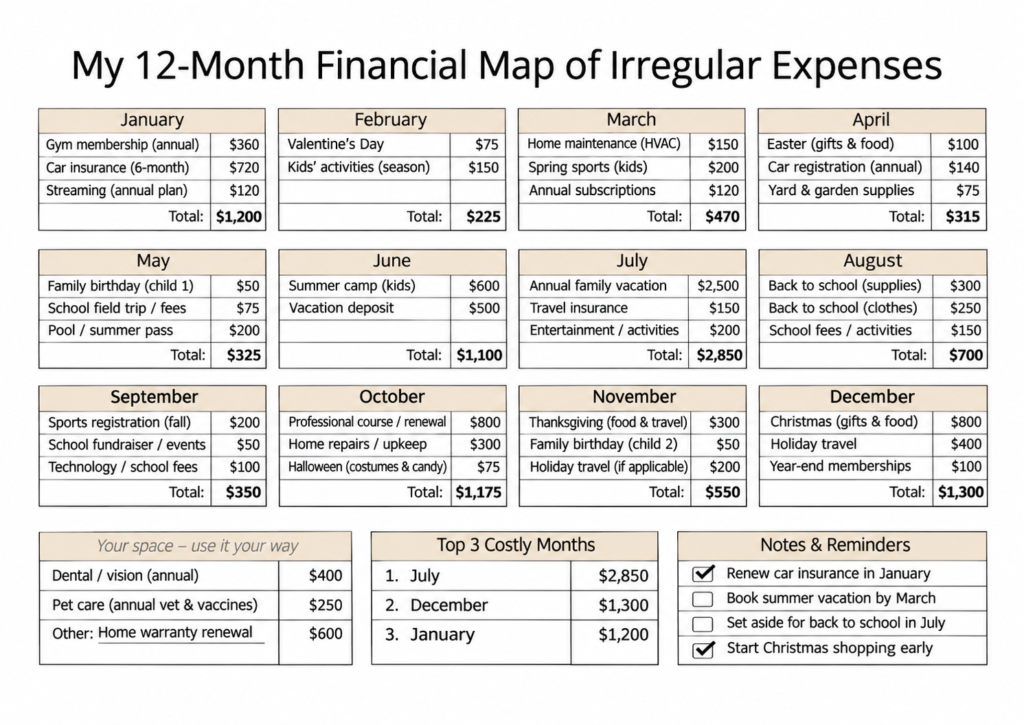
You now know the rough amount of every expense you have and the months those expenses come. Your yearly financial map will give you a visual of exactly how much money will leave your pocket each month of the year. You can print it and put it on your fridge or in any other more private place such as your bedroom, home office or planner (as long as you open it often).
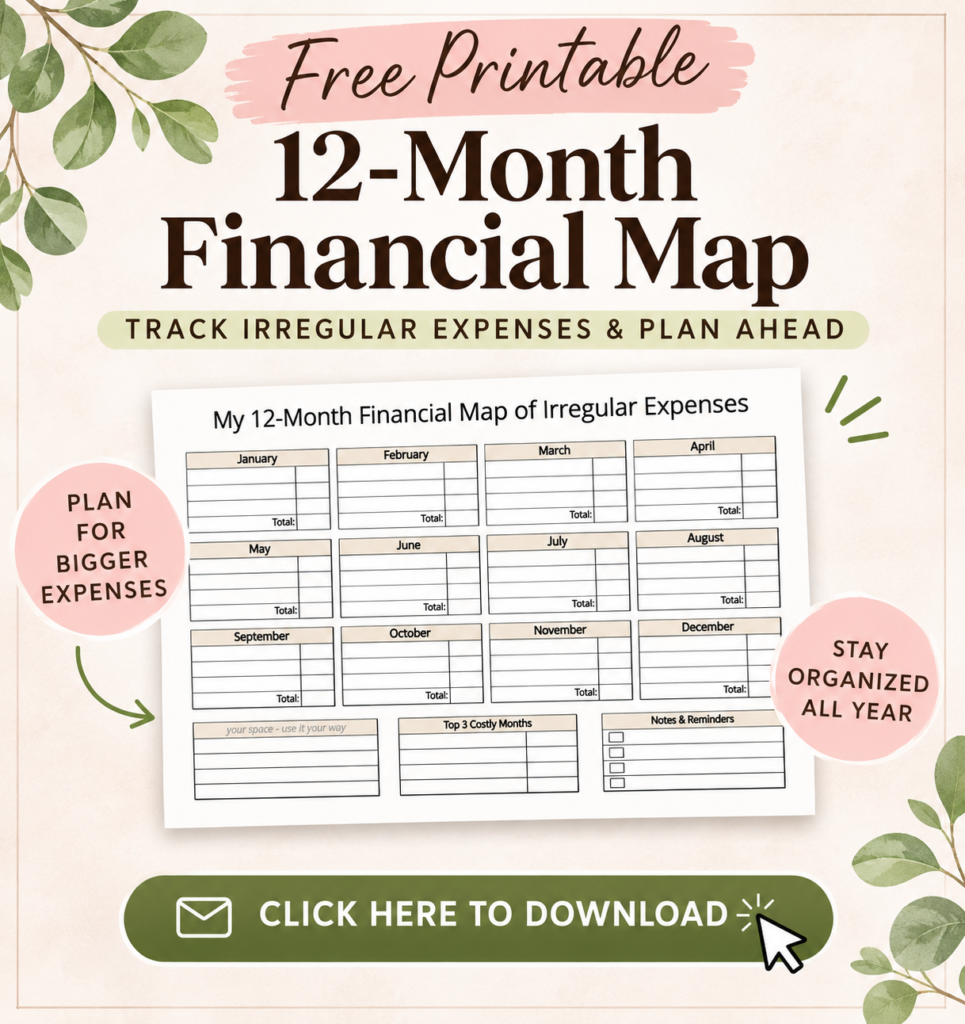
Action => Download my free yearly financial map, a gift to you, and fill it out.
I’ve created a sample calendar for you below, to give you an idea of what yours would look like.
Money Plan Step 5: Automate Your Sinking Funds
Action => Choose the way you will create your sinking funds and automate it as much as possible.
Your sinking funds are the whole point of creating this money plan for the next 12 months. That is, unless you do it for purely informational reasons and you don’t actually want to set aside any money in advance. I understand, and you can skip this section, if that’s the case.
But if you do decide to set aside any amount of money to help cover your most costly months, there are two ways to do it.
Option 1:
- Open a separate bank account that doesn’t come with a debit card. Even better if it’s in another bank and you don’t constantly check its balance. It will serve a specific group of your yearly expenses; you can make a list of those in your money planner. That means the money in the additional account will serve only those few events and nothing else.
- Think of an amount that you can set aside every month to go to that second bank account, then create an automaic transfer to do all the work for you. That’s it.
Option 2:
- You get cash envelopes;
- Assign names to each (names are the events you pay for);
- Every time you get paid, you withdraw money and put something in each envelope. You will need a separate tracking sheet for your sinking funds. You can choose the amount you set aside every month ,or you could decide on the amounts in advance and just follow through. There isn’t much room for automation here, which makes the previous option more convenient if it’s automation you’re after.
Creating Money Plan Step 6: Check and Update Your Money Plan
This step is self-explanatory. Check regularly to make sure everything goes as it should. Add or remove events from your yearly financial calendar and keep an eye on your automated sinking funds.
Tweak this money plan and its steps to fit your lifestyle and needs. Just because I’ve advised you to do it this way doesn’t mean it is the only way, and you can use it as inspiration only. Do what works for you.
Instead of Conclusion
I hope the 6-step money plan system was easy to understand and impelement, and I hope you found everything useful enough to try it. Becoming money-aware isn’t easy when we’re encouraged to spend and ignore our bank accounts as much as possible.
There is always something flashy to take our focus away so getting into the habit of saving, planning ahead, and sticking to our financial goals takes willpower and focus, which most of us struggle with.
If you find yourself overwhelmed or demotivated to keep going, it is okay. Take a break and come back in an hour, two days, or even a month. Try again, and I promise you, this time you will get further into planning it all out. The only way to fail is to stop trying, so keep trying again and again, and you will get there.

Blogger, dreamer, procrastinator, and lover of everything soul-touching. My mission is to make you laugh, provoke your thoughts, light up your day and inspire you to fall in love with life and yourself.